The real challenge for corporate travel programs is not just fuel-price volatility—it is understanding how carrier-imposed surcharges affect total ticket cost, realized savings, and airline competitiveness.
For many corporate travel buyers, 2026 was expected to bring greater stability to corporate airline pricing after several years of disruption. Instead, market conditions remain complex. Jet fuel prices continue to fluctuate, geopolitical uncertainty is affecting airline operating economics, and airfare structures are becoming harder to interpret.
While headline fare increases often attract the most attention, there’s an underlying pricing component that deserves closer scrutiny: carrier-imposed surcharges, often referred to as YQ/YR. Originally introduced during periods of energy price volatility, fuel surcharges were designed to help airlines offset rising fuel costs. Over time, however, many airlines have retained and reclassified them as broader carrier-imposed surcharges. As a result, the relationship between fuel prices and surcharge levels has become increasingly difficult for corporate travel buyers to assess.
While periods of rising fuel prices have often been accompanied by higher fuel surcharges, in recent years we’ve observed that surcharge reductions do not always mirror subsequent declines in oil prices. This means carrier-imposed surcharges can remain elevated even when fuel costs have moderated, making it difficult to determine how closely these charges reflect underlying cost movements.
Because these charges can represent a meaningful share of total ticket cost, understanding how surcharge trends evolve within broader airline fare structures is increasingly important for corporate travel programs. When surcharge levels increase without a clear explanation tied to fuel costs, market conditions, or other identifiable operating drivers, it becomes harder for buyers to assess airline competitiveness and the true value delivered by their airline agreements.
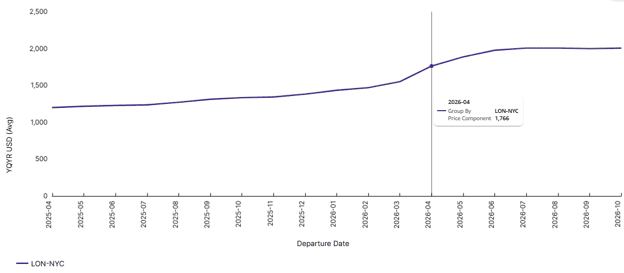
Air Fare Predictor Insight: YQ/YR evolution on market LHR to JFK in business cabin all carriers combined
Why carrier-imposed surcharges matter
Carrier-imposed surcharges often have the strongest impact on fares for long-haul and premium-cabin travel. For corporate travel programs, this matters because many negotiated airline discounts apply to the base fare rather than the total ticket value. When surcharges increase as a proportion of the fare, the effective value of negotiated discounts can be reduced. A discount may look competitive on paper, but deliver lower realized savings once non-discountable surcharges are included in the full ticket cost.
The challenge of airline benchmarking
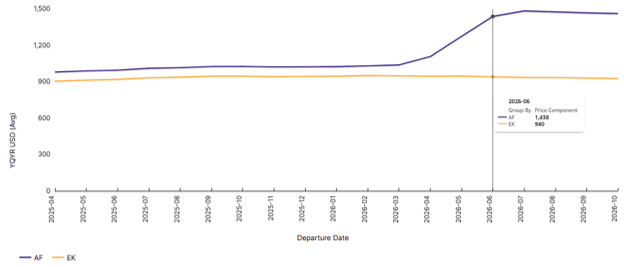
The challenge is not only the size of these charges, but also their inconsistency. Carrier-imposed surcharges can vary significantly by airline, cabin, route, point of sale, country of origin, and market conditions. Two similar itineraries may have materially different pricing structures, making direct airline comparisons more complex. The example below illustrates how surcharge levels can evolve differently across carriers within the same market.
Air Fare Predictor Insight: YQ/YR evolution on market CDG to DXB in business cabin with Emirates and Air France.
Transparency also varies across markets. In some regulated countries, like Japan, fuel surcharge methodologies are more clearly linked to published fuel-price benchmarks and reviewed on a regular schedule. In many other markets, carrier-imposed surcharges are determined with less transparency, resulting in greater variability across airlines, routes, and points of sale, which can make airline benchmarking more difficult.
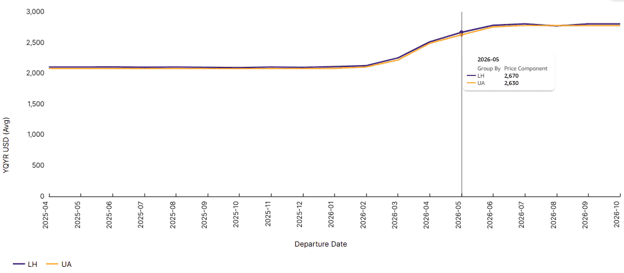
For example, when comparing business cabin flights between San Francisco and Frankfurt in May, we can see that the carrier-imposed surcharges on key airlines was around 80% higher departing out of San Francisco than out of Frankfurt.
Air Fare Predictor Insight: YQ/YR evolution on market FRA to SFO, business cabin
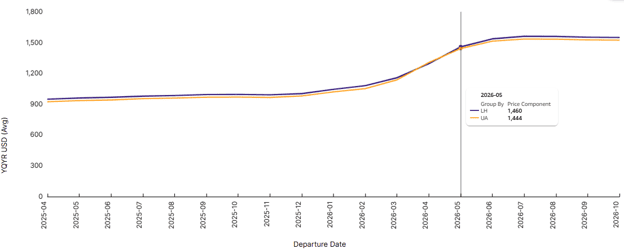
Air Fare Predictor Insight: YQ/YR evolution on market FRA to SFO, business cabin
What corporate buyers should do
For corporate travel buyers, the issue is not simply whether surcharges exist, but whether they are transparent, consistent, and justified by clear cost drivers. In today’s complex corporate air contracting environment, effective sourcing requires a broader view of ticket economics and airline performance. To maximize the value of airline agreements, travel managers should:
- Monitor carrier-imposed surcharge trends across preferred carriers and key markets, particularly on long-haul and premium-cabin routes where the financial impact is often greatest.
- Assess airline performance based on total ticket cost, not just negotiated base fare discounts, to understand the true level of realized savings.
- Investigate significant surcharge increases and seek clarification from airline partners when changes appear disproportionate or difficult to justify.
- Leverage alternative negotiation levers—such as stronger base fare discounts or additional commercial benefits—to offset surcharge-related cost increases.
- Adopt a data-driven negotiation strategy by combining airfare benchmarking, market intelligence, and predictive pricing analysis, like Advito’s Airfare Predictor, to better understand pricing dynamics and supplier competitiveness.
- Evaluate the full composition of airline fares, including the base fare, taxes, surcharges, and inventory availability, to identify emerging risks and opportunities.
Today’s leading travel programs are moving beyond headline discounts and taking a more holistic approach to airline sourcing. Advito’s air consultants combine market intelligence, predictive analytics, and benchmarking insights to help organizations make smarter sourcing decisions that drive real value. Contact our team to learn more.